
I have always maintained that marketing is not just about creativity and communication. More than anything, the goal of marketing is to contribute to the organisation’s growth. Marketers are not artists; we are employees whose activities should contribute to or impact sales.
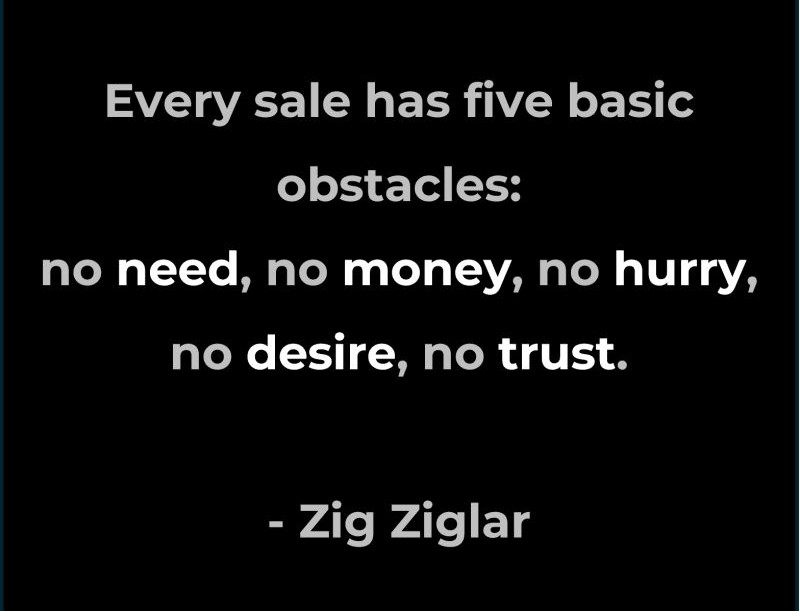
When it comes to obstacles to sales, the list of five basic sales obstacles given by Zig Ziglar is perhaps the best reference. It goes like this:
⚠️ 𝗡𝗼 𝗡𝗲𝗲𝗱: The prospect does not feel he/she has a valid reason to buy or switch.
⚠️ 𝗡𝗼 𝗠𝗼𝗻𝗲𝘆: The prospect lacks the funds or feels that the benefits do not sufficiently outweigh the costs (ROI).
⚠️ 𝗡𝗼 𝗛𝘂𝗿𝗿𝘆: The prospect does not have an immediate requirement or has other priorities.
⚠️ 𝗡𝗼 𝗗𝗲𝘀𝗶𝗿𝗲: Do not confuse this with need. No Desire signifies that the prospect lacks the emotional motivation to own the product.
⚠️ 𝗡𝗼 𝗧𝗿𝘂𝘀𝘁: The prospect does not have enough trust. It could be due to lack of awareness of the company / product, has negative views of the company or even the product category, or the salesperson seems to be of the snake-oil variety.
While a salesperson handles these in a 1-on-1 setting, a marketer must address them at scale.
Here’s how marketing can overcome these obstacles:
👉 𝗡𝗼 𝗡𝗲𝗲𝗱: Make them aware of their need. Content marketing to highlight problems, tools/calculators to reveal gaps, and ad copy that provokes negative emotions.
👉 𝗡𝗼 𝗠𝗼𝗻𝗲𝘆: Reframe your proposition to make ROI the hero. Calculators, trials, freemium models, tiered pricing are the ideal tools.
👉 𝗡𝗼 𝗛𝘂𝗿𝗿𝘆: Bring in urgency or show scarcity in supply. Limited time offers, What-if scenarios, exclusive events, early bird programmes.
👉 𝗡𝗼 𝗗𝗲𝘀𝗶𝗿𝗲: Tell a strong story. Show them the end-state, an aspirational self-image. Bring in brand ambassadors / influencers. Your communication should be as visual as possible.
👉 𝗡𝗼 𝗧𝗿𝘂𝘀𝘁: That’s the real challenge of brand building. Present social proof through genuine UGC content, give rational reasons-to-believe, bolster your authority through case studies and trust badges, educate on the product category. Be as transparent as possible.
Of course, a prospect rarely falls in all buckets. There is no single ICP. Identify your lucrative customer segments. Talk to your sales guys, analyse the tele-calling notes. Build detailed user personas to understand their motivations and fears, and then target these obstacles.
This article was first published on LinkedIn in January 2026. Link here.
 Vyuha Consulting
Leave your thoughts here